Monday, August 26, 2013

A Break from Shirtdresses - The Anna Dress!

The British blogosphere is abuzz with the Anna Dress from By Hand London!  I finally gave in and bought it when I saw the Anna Rose dress by Lizzy and Taracat's second version where she dances solo in front of the camera.  Because, really, how can you resist a pattern that makes you dance?  I actually put the vintage shirtdress I was in the process of making aside to make this dress, which never happens.

Without further ado:


Okay, these aren't the best photos - I thought taking them outside in the sunlight would be better, but no dice.  Here's a close up of the bodice:


An invisible zipper was really required of this dress since the neckline was so narrow - the pattern calls it a "slash neckline" which is a term I've never heard before.  As anyone who has read my blog for more than five minutes knows, I'm not a fan of sewing invisible zippers, but this one was okay, I guess:

Here's the skirt slit which I lowered several inches, so that it hit about four inches above the knee.  The original marking was much higher than I felt decency allowed: 


Since I wore it to work, I wore it with a sweater:

Okay, here are the details:  

For me, who buys the big four patterns when they are on sale for $ 1.99, this was an expensive pattern.  The cost of the pattern, plus shipping, plus the exchange rate, all added up to nearly $ 27.  Since I spent so much on the pattern, I felt duty bound to trace the pattern off just in case I guessed wrong on the size.  As you know I hate tracing patterns; I don't hate it as much as I hate putting in an invisible zipper, but I still hate it.

To make it palatable, I copied the facings on a regular copy machine, using 8.5 x 14 inch paper.  Problem solved there.  Then I traced the bodice front and back - I really didn't have much choice about tracing the front bodice as the slash neck and the v-neck were on the same bodice piece and I wanted to make sure I could make the v-neck version later.

I used a cotton lawn called "Modernology" by Art Gallery Fabrics which was 60 inches wide.  This pattern works best with a drapey fabric that is opaque enough not to show your unmentionables.  I originally wanted a rayon challis which has lovely drape, but I couldn't find one I liked locally, and I'm hesitant to buy rayon challis on-line as rayon challis quality can really only be determined in person.  I've used Kaffe Fassett rayons with great success - they are very high quality, but all others are suspect until I make my personal inspection to make sure they aren't too thin or too wrinklely.  

Interestingly enough, the instructions don't have you use any interfacing on the facings.  That was different, and I just rolled with it.  It worked great - the lack of interfacing meant the facing wasn't too stiff for the dress.  (I suspect modern patterns probably have us interfacing way more pattern pieces than necessary.) The bodice was easy - four pleats in front, two darts in back, sew on the facings, and hem the sleeves with a 1/2 inch hem (I topstitched mine).  

I tried on the bodice and decided the size I choose - size 8 US/12 UK - was perfect and didn't bother tracing the four skirt pattern pieces.  I couldn't stomach it.  Not only were there four pieces, but each piece was nearly 48 inches long.  My tissue paper would have to be piece together to even begin the tracing.  Life is too short.

It all went together in a day.  I used french seams on the skirt since your seams tend to show when you walk because of the slit.  They weren't hard; it was just a lot of straight sewing.

I held off on hemming until the next day, which was the smart move.  At five foot five inches, I don't think of myself as short, but hemming this dress was the most challenging part of the whole shabang.  Before I cut out the skirt, I measured the length of a maxi skirt I had made a couple of years ago, and figured I could wack about six inches off the skirt pattern.  I have, however, learned to rely on my math at my own peril.  So I limited my wacking to only 3 inches when I cut out the skirt.  After trying it on repeatedly (I really do need to get a dress form!), I turned the hem up another two and 5/8 inches.  I then trimmed the hem allowance to one and 1/4 inches, turned the raw edge towards the hem fold, and then machine stitched down the hem 5/8 inch from the fold.

Before I even finished the dress, I bought some fabric to make the "midi" version - the shorter version whose skirt is about 23 inches long - but after wearing the maxi dress all day, I can't imagine wasting time making the shorter version; the maxi dress is just so fabulous to wear.  The long skirt, with the slit, moves in such a wonderful way that feels elegant and lovely.  (My photos just don't capture this; Lizzy's photos of her Anna Rose dress does.) This dress is both modern and old fashioned at the same time.  Your skirts swish in a most expressive way - you can swish the skirt as you turn a corner, or you can pull your skirt back to show your disgust, which isn't possible with a short skirt, much less pants.  

Not to mention how the long skirt makes you look tall and thin!

The best thing that By Hand London did with this pattern was provide the finished garment measurements with their instructions - this is vital in choosing the best size, and something independent pattern makers usually fail to do.  The size 8 US/12 UK had finished measurements of 36 bust and 28 1/2 waist - I knew this would work for me.

To say I want to make the v-neck version now is like saying RGIII wants to play football.  And I've spotted a nice black-and-white rayon challis print at the local Hancock's I'm waiting for to go on sale.  So if you live in Richmond, don't buy it all before I get there, 'kay?

Saturday, August 17, 2013

How To Make a Dress from A Pack of Men's T-Shirts

While my sewing machine was in-hock this week for its bi-annual checkup, I spent a great deal of time thinking about sewing since I couldn't actually sew.  I thought back to the first dress I ever sewed - a Simplicity pattern v-neck dress number 9559 in a lavender and white Timeless Treasures quilting cotton (my mother has it now because it ended up a little too big).  And then I suddenly realized that it wasn't my first dress.

The first dress I sewed was the spring of my senior year in high school - in 1982 - as a result of seeing an article in a magazine (probably Seventeen since that is what I read at the time) which showed you how to make a dress from a package of three men's t-shirts.  The directions looked easy enough that even I could do it.  I followed the instructions, using my mother's sewing machine.  I was thrilled when it actually worked!  Unfortunately, no known photos of this dress survive.

My college roommate and I wore it relentlessly.  In summer we wore it with sandals; when it got colder, we wore it with a jean jacket, pearls, and saddle shoes.  Our waists were small enough that we used a bandana as a belt.  When "Flashdance" was released, I cut off the collar and left the collar edges raw.  We rolled up the sleeves.  I don't know what happened to the dress after college, and the magazine article is long gone, but I wondered if I could remember how to make it again.

So on Friday evening I was able to spring my Bernina out of maintenance prison and I decided to go to Target and buy a three pack of men's T-shirts:

Things have changed since 1982 - back then your only choice was white Fruit of the Loom.  I found you could get black, gray, blue, or a mixture of colors.  I went with black and it only cost me $ 12.99.

So here is how you make the dress.  Buy a 3 pack of men's shirts - whatever size fits you.  I went with a Small.  Wash 'em first.

Take one shirt and cut off the hem.  I decided I wanted the skirt to begin on my high hip.  I tried the shirt on, and marked my high hip with a pin:
The pin mark was 4 1/4 inches from the bottom of the hem, so I cut that amount off the t-shirt.  Here's what it looked like after I cut the hem off:
This will become the bodice of your dress.  Next take the other two t-shirts and cut the bottom of the shirts off right below the sleeves:
 Here's what one of the bottoms looks like after you cut it off:
Do the same thing for the other shirt.  These two bottoms will be used to make your skirt.  Cut up one side of each of the shirt bottoms.  You want to sew the two shirt bottoms together to form your skirt.  Basically, you are going from two short tubes to one long tube.  Join the two pieces together like so:
Sew your two side seams to form your bigger tube which will be your skirt:
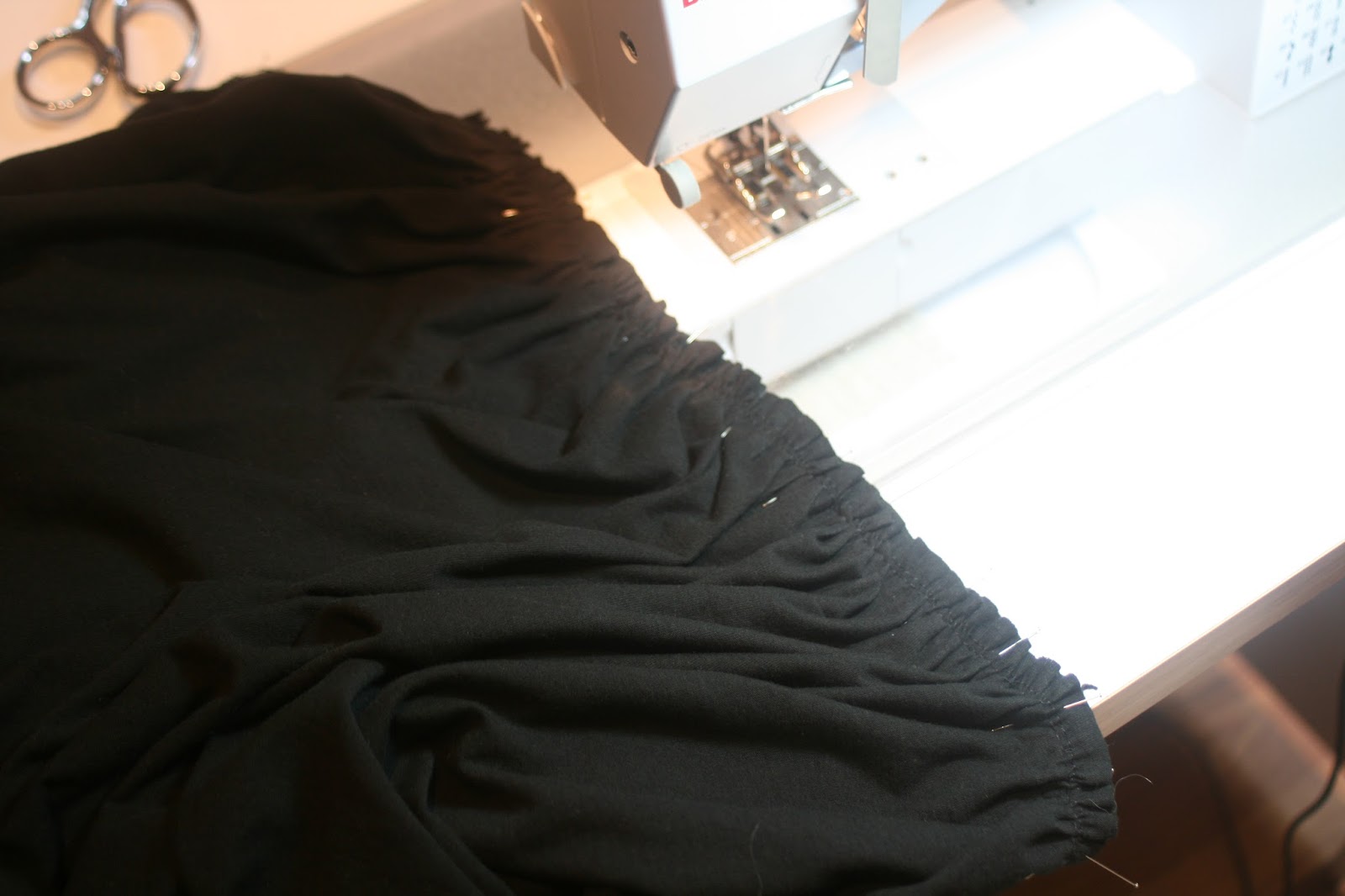
Next, gather this long tube and pin it to your first shirt that you are using as the bodice.  I remember the original instructions had you gather it by handsewing; this time I used a long machine stitch (stitch length 5).  Once gathered, sew your skirt to your "bodice":
I marked the sides and center front and back on my "bodice" and skirt to assist in adjusting the gathers, but I didn't get too precise about it - this is a $ 12.99 knit dress, after all.

This took less than an hour, even with taking photos.  Here it is:

I ended up cutting off the crew neck collar and turning the fabric under by one quarter of an inch and top stitching it down, rather than leaving it raw, Flashdance style.  The crew neck just seemed too high and itchy.  Of course, the accessory potential for this dress is endless.  I tried it on with jeans underneath and it makes a pretty cool tunic, too, which is how I am wearing it now as I type.

Here's a close up of the skirt:
Okay, I'm not as thin as I was in college, but this was fun to make.  You could also take a t-shirt you already own, use a 2-pack of men's shirts (Hanes t-shirts seem to come in twos these days) that either matches or contrasts for your skirt.  You could also use an old t-shirt you own, and look for an XL or XLL t-shirt at a thrift store to make a longer, but less gathered skirt.  Again, the possibilities are endless.

The major advantage of making your dress this way?  No hemming!!!!!  : )

Sunday, August 11, 2013

A Laura Ashley Sundress - McCalls 4444

 Lest you think that I only wear matronly vintage shirtdresses everyday (I wish!), I pulled this out from my closet for a barbeque The Carpenter and I attended Saturday afternoon.  It's McCalls 4444, a Laura Ashley pattern, which is still in print:


 Here's a bit of a closer view:


 I made this before I started blogging.  Based on who I was dating, I believe I made it in 2005.
As you can see it is "Easy McCalls".  I remember thinking while I was sewing it that it didn't seem particularly "easy" to me, but I had only been sewing for a few years.  Here's the back:
(Pay no attention to that bit of white around the zipper - that is something some hand sewing will soon fix.)  I made this from some raspberry pink and white polka dot quilting cotton which worked for this pattern.  I'm not wearing a "foundation garment", to put it delicately, and the two layers of quilting cotton provide plenty of coverage up top - no strapless bra necessary.  

I made View A, size 12 straight up, although I shortened those back bands by 7/8 inch (I'm reading from my notes as I type this).  Back in 2005, after I finished with each of my patterns, I made a photo copy of the front and taped it to a large manila envelope, and put the pattern pieces, instructions, and pattern envelope inside, along with a scrap of the fabric used.  On the outside of the envelope, I wrote notes about alterations, what size I made, and the grade I gave the pattern.  On this one, I graded the pattern an "A", and noted "not easy - ended up with good results".  

I would probably find this pattern easier to make now that I am eight years down the road in my sewing experience.  As a matter of fact, wearing this dress is giving me ideas . . .

Thursday, August 8, 2013

The Lock and Key Dress - Simplicity 6584

The Lock & Key Dress is done! And it took longer than I had planned.  (As per usual.)  I thought this would be a quick, non-complicated, novelty shirtdress, but I ended up putting in way more time than the dress pattern probably warranted:


I wrote about it here.  I finished it last night and wore it to work today.  (I find going to work is so much more exciting when I have a new dress to wear.)  So here it is:
And here's the back:
These are the changes I made:

1.  Decreased the waist seam allowances to 3/8 inch to give me one extra inch in the waist.  It fits perfectly now.

2.  Seriously shortened the sleeves.  I probably shortened them by nearly 6 inches when all is said and done.  I originally shortened them by 2 1/4 inches and put the sleeves in but they were miles long and looked like stove pipes.  So I shortened them yet another 3 1/2 inches.  Here's what they looked like before the final whacking:
These things were so long, they hit my elbow!  I estimate that putting in these sleeves and dealing with the length consumed about 2 1/2 to 3 hours of my time .  I seriously considered making this dress sleeveless, but I've reached that Certain Age where I can't regard my upper arms with any degree of acceptance.

3.  Used fusible interfacing instead of sew-in.

4.  Put in machine stitch buttonholes rather than bound buttonholes.  I wasn't about to do nine bound buttonholes . . .

5.  I made the sleeve "cuffs" like the Hawthorn dress.

6.  In addition to the bodice pocket, I put a patch pocket on the right side skirt piece, using the pattern placement on the pattern.  It resulted in a pocket 1/2 inch smaller than the pattern called for, but it is the perfect size to store my employee badge:
This pocket is so cool and I enjoyed using it all day.  I noticed that Trena added a waist loop for her employee badge on one of her dresses (but now I can't find which one); I might have to start adding a pocket to all my shirtdresses!

How you know this is a vintage pattern:

1.  The hem is deeper than modern patterns - 2 1/4 inches.

2.  There is nothing sexy about this dress.  The bodice is loose and not close fitting, the length of the dress is "correct" for the mid 1960s, i.e. just below the knee, and the buttons go all the way down to hem - heaven forbid there be a flash of leg!  Had I been paying attention, I probably would have left off the last one or two buttons.

3.  The instructions for this dress fit on one page which seems pretty typical for the era:
This caused me some consternation.  I'm used to patterns that have an illustration for each step.  I couldn't visualize every step in my mind, so I just took it slow, completing a step, then reading the next sentence, then completing the next step, and so on.  If I sewed as I read, the next step became clear.  This was the only way I got the collar constructed, as this method/collar was not familiar to me.

4.  The front and back skirt side pieces are slightly gathered, which makes altering the dress to fit a lot easier.  If you make any change to the tucks in the back bodice or darts in the front bodice, the skirt doesn't need any corresponding changes - you simply adjust your gathers.

Other notes:  I actually took the time to hand sew (!) a hook and eye closure at the waist to eliminate any gaping at the waist.  I had planned to use gray buttons, but saw these mint green ones, so I got both, and ultimately went with the green.  I got the belt at Target, and you can't see them, but my shoes match my belt.  This color combination of mint green and coral seem to be the "in" colors this summer.  So the dress is vintage, but the colors are up-to-date.  : )

Amazingly, for being such a non-sexy dress, I got compliments all day.  From people I didn't know.  In elevators.  I did enjoy wearing it. It was fun, it was comfortable, and I felt "cute".  This dress ended being one of those that was a PITA to sew, but a pleasure to wear.

So for the future, I'm going to have to look through my remaining shirtdress patterns, see what else is "on deck", and what I should make next!  With the completion of this dress, it was time (past time, really) to take the Bernina to the shop for a tune up; it was starting to skip stitches.  When the Bernina person told me it would be 7 to 10 days before my machine would ready for pick-up, I felt myself start to hyperventilate and wonder why I don't own a back up sewing machine after 11 years of sewing.  But then I remembered that I neglect housework and my husband for the amount of sewing I do now; the last thing I need is an additional machine to sew even more.  I have at least a week's worth of work in putting away patterns, cleaning up fabric, and reorganizing the sewing room.  And the ironing, my God, I have so much ironing to do . . .

Happy sewing, y'all.

Sunday, July 28, 2013

Unlocking That Dress

Next time I pledge to blog seven posts in seven days, I need to remember that a sewing blog is different than a slice-of-life blog in that you have to actually sew something to have something to talk about.  Well, you could talk about what other people are sewing, but that will wear thin pretty quickly.  So addition to taking the time to blog, you have add in the time it takes to sew, and that adds up to a lot of time.  Eventually (after 6 days, to be precise), your husband is probably going to need some attention.  : )

So the new shirtdress did not get cut out Friday night.  We are having unusually cool weather for July in Richmond, VA, and The Carpenter and I spend the evening on our back deck listening to the bird calls.

I awoke fresh on Saturday morning to begin my vintage shirtdress from the afore-mentioned "Lock and Key" fabric from Michael Miller.  This was the 1962 pattern I had my eye on:


I was drawn to the pattern for two reasons:  1) it was a shirtdress (obviously), and 2) it was a half-size pattern. You can see it is a size 14 1/2 whose bust size is 35. 


 Erin is big on half size patterns, which seem to be patterns whose bust measurement is "halfway" between two sizes, and whose waist size is slightly larger in proportion than misses sizes.  So, while a size 14 has a 34 bust, and a size 16 has a 36 bust, this 14 1/2 pattern is a 35 bust.  Given that I am a middle aged woman, a little extra in the bust and waist would be welcome without having to make alterations to the pattern.  I'm not entirely sure were I purchased this pattern, but I may have gotten it at Bygones in Carytown.  (Sadly, Bygones underwent a renovation several years ago and the last time I was there they no longer carried vintage patterns.)

After spending the last few weeks pouring over the instructions, I decided to make the slim skirted version to test this pattern - less time, less fabric.  But on Saturday morning, I pulled out the tissue pattern - still in factory folds - and found that the only pattern pieces inside the envelope were the four pattern pieces used to make the full skirt, and the pattern piece for the waist stay.  No bodice pieces, no sleeves, no collar; basically, no pattern pieces that I needed.  So, back to drawing board.

I went through my fairly extensive vintage pattern collection to try to find a shirtdress pattern that only needed three yards of fabric, and I chose this one, Simplicity 6584, from 1966:


I don't know where I got it, but it may have also been Bygones.  The pattern was published in London, and you may notice that it is "suitable for uniforms":


For some, this designation might be a deterrent, but because I am such an enormous sewing geek, I was all over it.  I can see nurses and waitress making this pattern in Britain for work in the 1960s.  I decided to make View 2, which is the short sleeve version with the A-line skirt.  Understandably, I was concerned about whether the pattern pieces were actually contained therein.  Not all of them were; the pockets were missing and so was the sleeve cuff, the waist stay, and the belt.  But thankfully all of the major pieces were there.

The pattern had been used before; the former owner had made the straight skirt version.  In cutting out, I did a little creative layout so I could align all the pattern pieces in the same direction - it's my belief that all fabrics have a nap, and I avoid cutting out pieces "upside down".  There's a little selvage in some of the seam allowances of my dress pieces, but I managed to get the entire dress cut out with the "with nap" layout.

I also decided to add the breast pocket, which I thought was really cute.  The front pattern piece shows the full pocket layout, so all I had to do was trace it to replace the missing pocket pattern piece:


I didn't add seam allowances so my breast pocket is 1/2 inch smaller overall than what the pattern calls for, but I like it a little smaller anyway.  After trying on the bodice, I added 1 inch to the waist by altering the side seams to 3/8 of an inch in the waist area. 

So here it is with no buttons, no edgestitching, no sleeves and no hem:


I really like the breast pocket!


I like this pocket so much, I might have to add one of the skirt pockets to this dress from the scraps, to complete the retro vibe.  

I tried this dress on, pinning the front closed, and it is surprising flattering, given that it is a "uniform".  I'll probably add gray buttons.  I am going to shorten the sleeves and eliminate the large cuff; I think I'll use the faux "cuff" a la The Hawthorn.  Hopefully, I'll finish this one soon.     

I always wonder about the prior owners of my vintage patterns - whether she was a nurse, or whether she used this pattern over and over, how old she was, etc.  I wonder if she was peering over my shoulder as I cut this one out!


Friday, July 26, 2013

Here's A Dress I Never Blogged About

I made my own wedding dress during my pretty short three-and-half month engagement.  I was hoping to blog about the process, but I was trying to throw together a wedding and make my dress at the same time.  Because my ability to put pressure on myself knows no bounds, I decided to make a dress for my bridal shower as well.   I never had time to blog about that dress either, but here it is:


In the top photo, I'm wearing a sweater because it was late January 2012, but in the bottom photo, you can see it is a sleeveless dress, made of shantung silk.  As you can imagine, I didn't have a lot of time to make this dress, so I planned a simple dress from tried-and-true patterns and techniques.  The bodice is the v-neck bodice from Simplicity 9559, now out of print:


I have a soft spot for this pattern because it is the very first dress pattern I ever made, back in 2002.  The bodice is made from the very small amount of white silk I had left after finishing my wedding dress; I liked the fact that I could incorporate a part of my wedding dress into this one.  The skirt is self-drafted half circle skirt in a dusty pink shantung I got on sale for $ 10/yard at Fabric Mart up in Massachusetts back in 2003 or 2004, before it went out of business.  Which is complete proof that not only should you have a stash, but you should have completely "useless" fabrics in it because you just never know.  : )

Influenced heavily by Mary Adams', The Party Dress, I added a liberal amount of ruffles.  I think I even bought a ruffler foot for my Bernina for this exact purpose.  (Which was the most expensive part of making this dress.)  Mary Adams makes her ruffles with bias strips, not bothering to hem them, so I gave it go and it was a lot of fun.  I made the white ruffles around the neckline and waist with Kaufman's silk/cotton blend fabric that I had auditioned for my wedding dress but ultimately decided not to use.  For the skirt, I used the rose shantung; my original plan envisioned at least two or three rows of ruffles but I ran out of fabric and had to make do with only one.  

I hemmed the dress with a bias strip folded in half a la Kay Whitt of Sew Serendipity, a technique I have used on a lot of my formal dresses - it's easy and creates a smooth, pucker-free hem.

This was an over-the-top frilly, girly dress. And just to gild the lily, I wore it with a full crinoline underneath!  But if you can't wear a ruffled silk dress at your bridal shower, where can you wear it???  I ended up wearing it for the rehearsal dinner as well.  Like my wedding dress, I felt comfortable, I felt the dress was "me", and I felt "cute".  Which is the trifecta of dress making!

Looking at these photos reminds me of what a great shower I had - the classic southern women's bridal shower, complete with pimento cheese sandwiches, deviled eggs, and petite fours.  So many of my wonderful friends made it a memorable day and I will be forever grateful . . .

Thursday, July 25, 2013

What We Wear . . . and Why

Have you seen Sewaholic's newest pattern, the Saltspring dress?  It is absolutely adorable.  And for about five minutes, I looked for the perfect rayon challis to make the maxi dress version and then I remembered I'm forty-nine years old and the dress design, while adorable, is too young for me.  Not wanting to give up, I actually considered making it for Aimee's fifteen year old daughter, who would look so crazy cute in it, but I realized the Selfish Seamstress would feel a great disturbance in The Force if I actually volunteered to sew for someone else.  I reminded myself of the dozen and dozens of patterns I already own that I will never be able to wear because time is flying by and I'll grow so old my arthritic fingers will wither, and I finally regained my senses.

And that got me thinking about what we wear, and what I wear, and what is in fashion. It was a classic sartorial existential crisis, dear readers.  Because, basically, I believe anything goes these days, despite what fashion magazines portray and Target sells. The incredibly popularity of vintage patterns and reissues of vintage patterns are a testament that sewers, at least, pay little attention to Vanity Fair.

And I truly believe that other people do not care one whit what I wear, as long as what I wear is clean and not too revealing.  I would venture to say that my co-workers aren't the least bit surprised by anything I wear because I've been there 20 years and not only have I worn a dress with blue crabs on it, but if I really like something, I literally wear it for years.  I could show up wearing a tiara (and I have) and they barely shoot me a glance.

So how could a cute dress pattern be "too young" and therefore unacceptable?  I don't know, but instinctively I knew it was.  I was deeply struck by Trina's post from some years back about her philosophy of dressing - that her goal was to feel cute every day, and any clothes that didn't produce such feeling were ditched.  Gone were the practical "work clothes" - she wears what makes her happy and makes her feel cute and I think she's right on the money.   Particularly since I believe, as stated above, people do not truly care what others wear.

Any dress that makes me uncomfortable, either physically or emotionally, isn't going to make me feel great about the day.  If I am wearing something "too young" I am going to feel self-conscious, which is the antithesis of "cute".  "Too young" is any dress that makes me feel ridiculous, and that is saying something for someone whose favorite dress has blue crabs on it.  But that dress makes me feel fab (sorry Vicki) and I remember dancing around it the day I finished it.  It's like we were meant for each other.

So I'm passing on the Saltspring maxi dress, even though I know that maxi skirt would feel amazing fluttering in a summer evening breeze, and I'm going with a vintage shirtdress pattern I've been wanting to try for several years because 2013 is the Year of the Shirtdress.  And after seeing Erin's dress, I am making it in Michael Miller's "Lock and Key":


So yeah, the Saltriver dress is too young for me, but I'm going to be wearing a 1962 shirtdress that has keys on it.  Which just demonstrates that "appropriateness" is all relative, dear readers.  We live in a era where we each get to decide what is right for us, whether it is the latest from Michael Kors or whether it is a 1950s wiggle dress we sewed ourselves, and no one cares.

In a perfect world, I'll cut this baby out tomorrow night so I can just start sewing Saturday morning after my cup of tea and chocolate for breakfast while I watch "This Old House".  Because that is how I roll, people.